Sewer Line Replacement Cost
National planning ranges, installed: $50–$250 per linear foot, $2,000–$10,000 for a typical 40 foot run. Trenchless lining or bursting $60–$250 per foot; under a slab $300–$350 per foot. A camera inspection first is $125–$500 and can save you the whole job. Here is what moves your number.
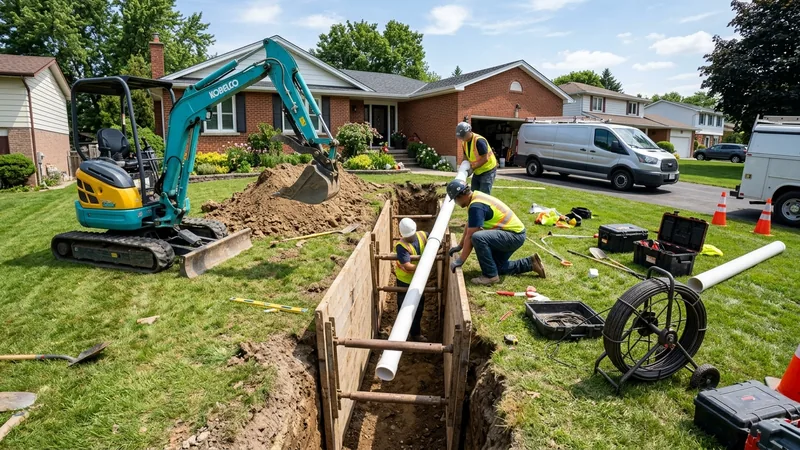
- Typical range$2,000 – $10,000
- TradePlumbing
- Read time7 min
- Data tables2
- StatusUpdated September 2026
Full replacement, house to main, 40 foot run, installed, September 2026
$2,000 – $10,000
Per foot: open trench $50–$250, pipe bursting $60–$200, cured-in-place lining $80–$250. Spot repair of one section $600–$1,050. Camera inspection $125–$500. Restoration of lawn, driveway or slab is on top.
Published averages sit below our band. Angi and HomeAdvisor both report $1,388–$5,323 with an average of $3,319, Bob Vila $1,253–$4,701 with a $2,914 average, and This Old House $1,390–$5,320. Those numbers mix short partial repairs with full runs. HomeGuide's per-length table is the honest planning tool: $2,000–$10,000 for 40 feet, $3,000–$15,000 for 60 feet, $4,000–$20,000 for 80 feet. Residential laterals typically run 50 to 75 feet, so most complete replacements land between $3,000 and $12,000 before restoration.
Trenchless vs dig: what each method costs per foot
| Method | Per linear foot | Notes |
|---|---|---|
| Open trench, dig and replace | $50 – $250 | Bob Vila says most jobs land at $50–$125. Excavation $50–$200 per foot extra when deep or under obstacles; trenching alone is $4–$12 per foot |
| Pipe bursting (trenchless) | $60 – $200 | A new HDPE pipe is pulled through as the old one is split. Two access pits. Can upsize the pipe. Angi prices bursting with lining at $150–$190 |
| Cured-in-place lining, CIPP (trenchless) | $80 – $250 | Epoxy liner cured inside the old pipe. One access point. Angi lists $135–$150 for lining alone; HomeGuide $90–$250. Needs an intact host pipe |
| Spin-cast lining | $80 – $250 | Resin sprayed inside the pipe. Same limits as CIPP |
| Under a concrete slab | $300 – $350 | Angi, HomeAdvisor and Bob Vila agree. Cutting and repouring the floor is most of it |
| Spot repair, one section | $600 – $1,050 | HomeAdvisor. Angi's repair average is $2,600 with a range of $1,100–$4,100 |
Angi's rule for trenchless is blunt: it is not suitable for a collapsed pipe or one with the wrong slope. A liner cannot pass through a crushed section and no trenchless method fixes a belly. Angi's trenchless project range is $1,900–$6,000 with a $2,900 average, and its per-length table runs from $1,500–$8,750 for 25 to 35 feet up to $4,500–$25,000 for 75 to 100 feet. HomeAdvisor and Angi price an unavoidable excavation at $400–$1,200 per 100 feet on top of the pipe work.
What drives the price
| Driver | Impact | Notes |
|---|---|---|
| Length | $50 – $250 per foot | Distance from the house cleanout to the city main. Angi: ten extra feet can add thousands |
| Depth and soil | $50 – $200 per foot | Angi's excavation range. Frost-line depth in cold states, clay and rock all add crew hours and shoring |
| What is on top | $300 – $350 per foot under slab | Concrete removal $3–$8 per square foot (HomeGuide). Driveway repair $100–$400 minor or $600–$3,000 major. Landscaping $4.50–$12 per square foot |
| Camera inspection | $125 – $500 | HomeGuide with a cleanout; $175–$750 without one (toilet pull). Angi's 2026 average of $995 covers long, complex or HD-recorded scopes |
| Permits | $100 – $1,000 | This Old House. Angi says a trenchless permit can reach $1,000. Connecting to the city main is a separate permit at $400–$1,600, about $1,000 (HomeAdvisor) |
| Cleanout and backflow | $650 – $3,200 | New cleanout $500–$2,000 (HomeGuide). Backflow preventer $150–$1,200. Many cities require both on a replacement |
| Labor rate | $45 – $200 per hour | Angi. Sewer work is usually priced by the foot or flat, and labor is about 80% of it |
| Pipe material | $3 – $80 per foot | PVC $3–$8 per foot, ABS $3–$11, cast iron $20–$75, copper $30–$80 (HomeGuide). PVC is the default; material is a small share of the bill |
Regional ranges
HomeAdvisor's city averages for a new sewer line show the labor and permit spread: Dallas $1,630, Miami $1,760, Chicago $2,310, Boston $2,420, Houston $2,940, New York $3,400, Detroit $3,420, Los Angeles $4,130 and Portland $4,160. Angi frames it as about $2,000 in Austin against $4,000 in Los Angeles for the same job. Bob Vila adds the climate effect: $600–$2,300 in Atlanta versus $1,800–$6,000 in Minneapolis, where lines sit below a deep frost line.
Start with the camera, not the backhoe
Every sewer job should begin with a video inspection: $125–$500 per HomeGuide, $100–$500 per Angi and HomeAdvisor. The footage tells you which of four things you have. A root intrusion at one joint is a hydro jet ($600–$1,400) and maybe a spot repair, not a replacement. A bellied section is a short excavation of that section. A cracked but round pipe is a lining candidate. A collapsed or offset pipe is a dig. ContractorRanks' 2026 warning is worth repeating: the diagnosis costs a few hundred dollars and the replacement pays thousands, so some contractors skip the camera and recommend replacement from "experience." Pay for an independent scope from a plumber who is not bidding the repair, and ask to watch the footage. On homes older than 20 years, HomeGuide notes a sewer scope adds only $100–$250 to a standard home inspection; it is the best money in the purchase.
Who pays: you, your insurer or the city
The lateral from your house to the city main is yours. In most cities that includes the section under the sidewalk and street, and HomeAdvisor notes the property owner is typically responsible for improvements on their land plus the connection fee. Cutting a public street adds a second permit layer: in Northern Virginia, for example, state road permits stack on the county plumbing permit and Arlington requires contractors to post a $5,000 street bond, which is one reason a trenchless job that starts and ends in your yard can beat a dig even at a higher per-foot rate. Call the sewer authority before you sign; some cities own the lateral from the property line out, and a few run repair programs.
Standard homeowners insurance (HO-3) excludes the underground pipe for age, wear and tree roots, which cause most failures. Angi's summary: a sudden event like a fallen tree may be covered if you can prove the pipe had no existing weakness. A sewer backup endorsement pays for cleanup inside the house ($500–$10,000 per Angi), not the pipe. Dedicated service line coverage runs $5–$15 a month through utilities and warranty companies or $30–$80 a year as an endorsement, with limits usually at $10,000 and some plans at $25,000 and deductibles from $0 to $1,000. Read the cap against the quotes above: a $10,000 limit with a $500 deductible leaves you $5,500 short on a $15,000 dig.
DIY vs pro
Sewer replacement is permitted, inspected work involving deep trenches and a live connection to a public utility. Deep trench walls need shoring, and a cave-in is lethal. Leave it to a licensed plumber or excavation contractor. What you can do yourself: rent a camera ($120–$225 a day per HomeGuide) to check a slow drain before calling anyone, keep the trench area clear, and handle the lawn and sod repair ($1–$2 per square foot installed) after backfill instead of paying the plumber's landscaping rate.
Quick answers
How much does sewer line replacement cost in 2026?
Plan on $50–$250 per linear foot installed, or $2,000–$10,000 for a typical 40 foot run, as of September 2026. Angi and HomeAdvisor report most homeowners pay $1,388–$5,323 with an average of $3,319, but that blends partial repairs with full replacements. A long, deep line under a driveway or street can reach $20,000–$25,000.
Is trenchless sewer replacement cheaper than digging?
Per foot, no: trenchless runs $60–$250 against $50–$250 for open trench. On the total, often yes, because trenchless skips most restoration. Excavation is $50–$200 per foot, breaking a concrete slab is $300–$350 per foot, and landscaping repair is $4.50–$12 per square foot. Trenchless does not work on a collapsed pipe or one laid at the wrong slope; the camera inspection decides.
Does homeowners insurance cover sewer line replacement?
Usually not. A standard HO-3 policy excludes the underground lateral for wear, age, and tree roots, which cause most failures. It may pay for a sudden event like a fallen tree if you can show the pipe was sound. Sewer backup endorsements cover the mess inside the house, not the pipe. Service line coverage is $5–$15 a month or $30–$80 a year as an endorsement, typically capped at $10,000 with some plans at $25,000.
Before you sign: get the camera footage and the measured length in writing, confirm the method and every restoration item, and ask who pulls the street or utility connection permit. See how to read a contractor quote. Tearing up the driveway anyway? Price a new one with our driveway paving cost guide.
Sources
- Angi: Sewer line replacement cost, 2026 data
- Angi: Trenchless sewer line replacement cost, 2026 data
- Angi: Sewer line repair or replacement costs by method
- Angi: Sewer camera inspection cost, 2026 data
- Angi: Does insurance cover sewer line replacement?
- HomeAdvisor: Cost to replace a sewer line
- HomeAdvisor: Sewer line installation cost by city
- HomeGuide: Sewer line replacement cost by length and method, 2026
- HomeGuide: Sewer camera inspection cost, 2026
- This Old House: Sewer line replacement cost
- Bob Vila: Sewer line replacement cost by city
- LegalClarity: Is sewer line insurance worth it? Coverage limits and HO-3 exclusions, 2026
- ContractorRanks: Sewer line replacement cost, trenchless vs dig, 2026
- SwiftPro via App.com: Sewer permit and street bond costs, Northern Virginia, 2026
- Angi: Sewer cleanout cost, labor share and sewer line insurance, 2026
- Most Recommended Plumbers: Trenchless cost, bursting vs lining, typical lateral length, 2026
More cost guides
 Plumbing
Water Heater Replacement Cost
Tank $1,200–$3,500 vs tankless $3,000–$6,500+, installed.
 Plumbing
Water Softener Cost
$1,000–$3,000+: sizing and salt math.
 Driveways and decks
Driveway Paving Cost
$7–$18 per sq ft: asphalt vs concrete vs pavers.
 Bathroom
Bathroom Remodel Cost
Where the drain and rough-in money goes.