How Much Does a Water Softener Cost?
From basic single-tank units to whole-home reverse osmosis, find out what you will actually pay to treat hard water in your home.
On this page
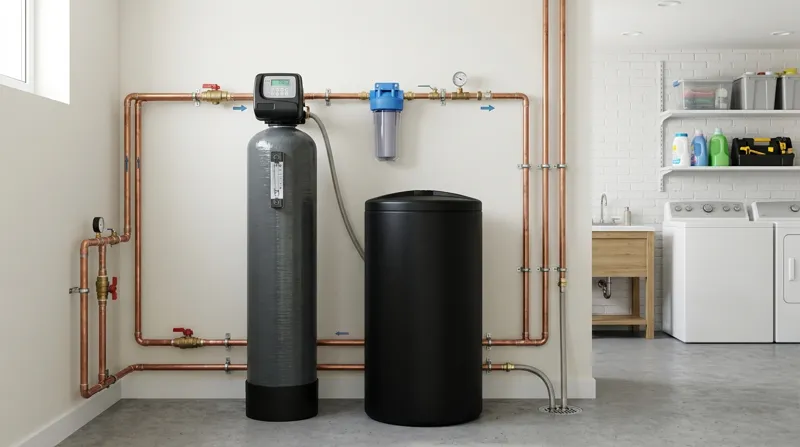
- TradePlumbing
- Read time4 min
- Data tables2
- StatusResearch updated 2026-09-24
Cost by System Type, Installed
The total cost to purchase and install a water softener ranges from $1,100 to $3,000 on average, with most homeowners spending around $2,500 for a professionally installed dual-tank ion exchange system [Fixr]. Depending on the technology you choose, overall project costs can start as low as $200 for simple magnetic descalers and reach up to $11,000 for whole-home reverse osmosis systems [Angi].
Different systems use distinct methods to address mineral buildup. Traditional salt-based systems physically remove minerals, while salt-free systems condition them so they cannot stick to surfaces [Department of Energy].
| Water Softener Type | Average Installed Cost Range |
|---|---|
| Magnetic Systems | $200–$600 |
| Single-Tank Ion Exchange | $500–$1,700 |
| Dual-Tank Ion Exchange | $1,000–$5,000 |
| Salt-Free Systems | $800–$4,000 |
| Water Distiller Systems | $1,200–$4,000 |
| Reverse Osmosis (Whole-Home) | $4,000–$11,000 |
Note: Cost ranges are compiled from national data provided by Angi, HomeGuide, and Fixr [Angi] [HomeGuide] [Fixr].
Unit Price by Grain Capacity
If you are purchasing the equipment separately, the price of the unit itself is largely determined by its grain capacity. This capacity refers to how many grains of hardness minerals the system can filter out before it must run a regeneration cycle to clean its resin bed [This Old House].
| Water Softener Capacity (Grains) | Average Equipment Cost (Materials Only) |
|---|---|
| 24,000 | $300–$500 |
| 32,000 | $400–$1,000 |
| 48,000 | $600–$1,200 |
| 64,000 | $800–$1,500 |
| 80,000 | $1,500–$1,800 |
| 96,000 | $1,700–$2,500 |
Sizing: The Grain Math
Choosing a system that is too small will cause it to regenerate too frequently, which wastes water and salt while shortening the system's lifespan [HomeGuide]. To find the correct capacity for your home, you can use a standard sizing equation [Angi]:
(Number of People) × (Daily Water Usage per Person) × (Water Hardness in GPG) × 7 Days = Required Weekly Capacity
Hypothetical Sizing Example
Let's calculate the needs of a family of four living in an area with moderately hard water:
- Household size: 4 people
- Average daily water use: 90 gallons per person [Angi]
- Water hardness: 10 GPG [This Old House]
The math: 4 people × 90 gallons × 10 GPG × 7 days = 25,200 grains.
In this scenario, the family should look for a system with a minimum capacity of 28,000 to 32,000 grains to ensure they do not run out of softened water during peak usage times [This Old House].
What Drives the Installed Price?
When a professional plumber evaluates your home for a water softener, several variables will dictate the final quote:
- Plumbing Modifications: If your home already has a dedicated "softener loop" installed, labor will be minimal. If the plumber has to cut into your main water line, run new drain lines, or reroute pipes, expect to pay $0.50 to $8 per linear foot for new pipe installation [Angi].
- Electrical Upgrades: Some systems require a dedicated electrical circuit [HomeGuide]. Installing a dedicated electrical circuit costs $250 to $900 [HomeGuide].
- Single vs. Dual Tank: Single-tank systems ($650–$1,500 installed) interrupt your soft water supply during their self-cleaning regeneration cycle [Fixr]. Dual-tank systems ($1,500–$3,000 installed) feature two resin tanks so that one can provide soft water while the other regenerates, ensuring continuous service [Fixr] [Department of Energy].
Running Costs per Year
Owning a water softener comes with ongoing operational expenses that you should factor into your household budget:
- Salt Refills: Traditional salt-based systems require regular replenishment. A standard 40-pound bag of water softener salt costs $5 to $10 [Angi]. If you prefer potassium chloride (often chosen for low-sodium diets), a 40-pound bag costs significantly more, ranging from $50 to $70 [Angi].
- System Maintenance & Repairs: Standard repairs average $150 to $900, though major component failures can cost up to $2,000 [Angi].
- Reverse Osmosis Filters: If you install a whole-house reverse osmosis system, replacement filters cost $30 to $150 every 6 to 12 months, and the main membrane costs $40 to $250 every 2 to 3 years [HomeGuide].
Is It Worth It? The Hardness Line
According to the U.S. Geological Survey (USGS), water hardness is determined by the concentration of dissolved calcium and magnesium [USGS]. While hard water is safe to drink, it can cause scale buildup inside pipes, reduce the efficiency and lifespan of water heaters, leave spots on dishes, and prevent soaps from lathering properly [USGS].
To determine if you need a system, check your water utility's annual report or purchase a home test kit. The USGS classifies water hardness by milligrams per liter (mg/L) [USGS], which translates to grains per gallon (GPG) to help determine treatment needs [HomeGuide]:
- Soft: 0 to 60 mg/L (0 to 3.5 GPG) - No treatment needed.
- Moderately Hard: 61 to 120 mg/L (3.5 to 7 GPG) - May benefit from softening.
- Hard: 121 to 180 mg/L (7 to 10 GPG) - Softening is highly recommended.
- Very Hard: Over 180 mg/L (10+ GPG) - Softening is essential to protect plumbing and appliances.
DIY vs. Pro
While plug-in magnetic systems do not require plumbing modifications [Department of Energy], hiring a local professional to install a traditional ion exchange system ensures that the unit is sized correctly, set up faster, and installed with the technical expertise needed to prevent water-related damage [Angi].
Before signing a contract, ask your installer if the quote includes the removal and disposal of any old equipment, and verify whether they will handle the necessary municipal plumbing permits Learn how to read a contractor quote.
Quick Answers
Can I rent a water softener instead of buying one?
Yes. If you do not want to pay the upfront purchase and installation costs, many water treatment companies offer rental programs that cost between $25 and $50 per month [Angi].
Does a water softener make drinking water taste salty?
No. While salt-based systems use sodium to clean the resin beads, only trace amounts of sodium are actually introduced into your drinking water [Department of Energy]. If you are on a strict low-sodium diet, you can use potassium chloride instead of salt, or opt for a salt-free conditioning system [Department of Energy].
More Cost Guides
Compare two quotes on the same scope
Illustrative inputs. Add confirmed extras once; do not double-count items already included. This compares totals, not workmanship, licensing or contract terms.
Sources and research notes
Research checked 2026-09-24. Source comparison; this is a research synthesis. Findings attributed to other reviewers remain their work.
- Water Softener System Installation Cost [2026 Data] | Angi
- Hardness of Water | U.S. Geological Survey
- Purchasing and Maintaining A Water Softener | Department of Energy
- How Much Does a Water Softener System Cost?
- Water Softener Installation Cost | Water Softener System Cost | Fixr.com
- How Much Does a Water Softener Cost? (2026)
What the evidence does not establish
- Local plumbing rates and permit fees vary significantly by municipality.
- Water chemistry and flow rates can affect the performance of magnetic and salt-free systems.
Keep reading
 Plumbing
How Much Does Sewer Line Replacement Cost?
Discover the costs of sewer line replacement and repair in 2026. Compare trenchless vs. traditional excavation, pipe materials, and learn what to expect before hiring a pro.
 Plumbing
How Much Does Water Heater Replacement Cost?
Planning to replace your water heater? Compare costs for tank, tankless, heat pump, and indirect systems, including labor, fuel types, and energy savings.