Electrical Panel Upgrade Cost
National planning ranges, installed: 100 to 200 amp upgrade $1,500–$4,000, like-for-like panel replacement $1,200–$2,500, subpanel $400–$1,750, 200 to 400 amp $3,500–$8,000+. Add a new meter base and utility work and a full service upgrade reaches $6,000. Here is what moves your number.
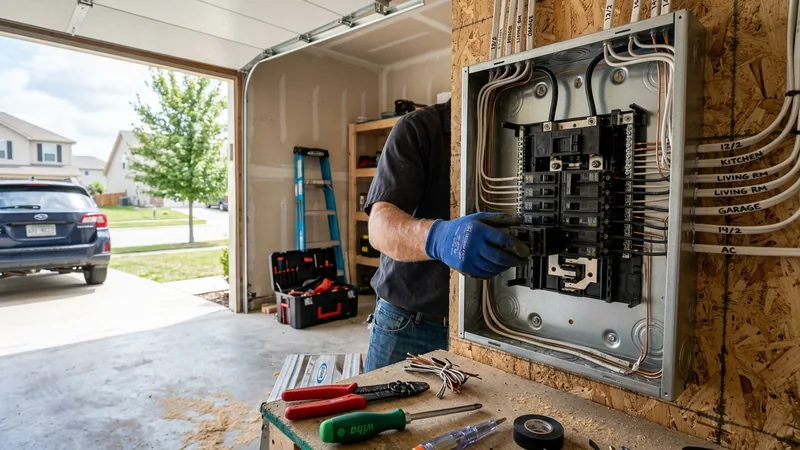
- Typical range$1,500 – $4,000
- TradeElectrical
- Read time7 min
- Data tables3
- StatusUpdated September 2026
100 to 200 amp service upgrade, panel in the same location, installed, September 2026
$1,500 – $4,000
Same-amperage panel replacement: $1,200–$2,500. Full service upgrade with new meter base and service entrance cable: $2,500–$6,000. Subpanel: $400–$1,750. Level 2 EV charger circuit and unit: $1,200–$3,000.
Published averages run lower than our band. Angi's 2026 figure for a 200 amp panel is $1,300–$2,000 and HomeAdvisor reports $518–$2,192 with an average of $1,346, but both describe swapping the box on the wall. Fixr says most homeowners pay about $3,000 to go from 100 to 200 amps, and HomeCostLab's 2026 average is $2,200. The gap is the service side: a bigger main breaker needs bigger service entrance conductors, often a new meter base, a utility disconnect and reconnect, and sometimes new grounding. Our range assumes those items on a house with normal access, so quotes should land inside it.
What each job costs installed
| Job | Range | Notes |
|---|---|---|
| Panel replacement, same amperage | $1,200 – $2,500 | Failed, recalled or full panel swapped for a new one. HomeAdvisor's typical $518–$2,192 covers the simplest of these |
| Federal Pacific or Zinsco replacement | $1,500 – $4,000 | HomeAdvisor's range. These panels have known breaker failures; replace them regardless of amperage |
| Fuse box to breaker panel | $1,500 – $4,500 | Usually on 60 amp homes, so it becomes a 100 or 200 amp upgrade with some rewiring |
| 100 to 200 amp upgrade | $1,500 – $4,000 | The most common job. Fixr $1,800–$4,500; This Old House $1,300–$3,000; Thumbtack $1,300–$3,000 |
| Full service upgrade with new meter base | $2,500 – $6,000 | Adds service entrance cable, meter socket and utility coordination. SparkPro's 2026 range is $2,500–$5,000 |
| 200 to 400 amp upgrade | $3,500 – $8,000+ | Large homes, workshops, multiple EVs. Fixr sees $8,000–$12,000 where a second panel and new service drop are needed |
| Subpanel, 50 to 60 amps | $400 – $600 | Garage, shed or kitchen remodel. Part is only $20–$90 (HomeGuide) |
| Subpanel, 100 to 125 amps | $500 – $1,500 | Additions, EV chargers, workshops. Wiring runs cost $7–$10 per foot on top |
| Relocate the panel | $1,500 – $4,000 | HomeAdvisor. Often required when moving a panel out of a closet or bathroom to meet code |
What drives the price
| Driver | Impact | Notes |
|---|---|---|
| Labor | $800 – $2,000 | 4 to 8 hours at $100–$250 per hour (HomeCostLab). Angi's national labor average is about $1,500. Labor is most of the bill |
| Panel and breakers | $100 – $800 | A bare 200 amp loadcenter is $100–$500 (HomeAdvisor); a quality panel with a full set of breakers $300–$800. AFCI and GFCI breakers add $10–$100+ each |
| Meter base and service entrance | $200 – $800 | Angi prices meter box replacement at $200–$800. HomeAdvisor lists a new power supply and meter at $100–$650 |
| Permit and inspection | $50 – $500 | Angi $50–$300; HomeCostLab $100–$500. Northeast towns often require two inspections at $200–$500 total |
| Utility coordination | $0 – $2,000 | Meter pull and reconnect is often free but adds scheduling delay. If the utility must upsize the service drop, US Home Renovations sees $500–$2,000 and 1 to 4 weeks of lead time |
| Drywall and finish repair | $150 – $300 | HomeAdvisor. More if the panel moves or walls are opened for new home runs |
| Grounding and bonding fixes | $100 – $600 | Old homes often need new ground rods, a water bond and surge protection ($70–$700 per HomeAdvisor) to pass inspection |
Regional ranges
| Region | 100 to 200 amp upgrade | Notes |
|---|---|---|
| Northeast (NY, MA, NJ) | $2,800 – $5,500 | Electrician rates of $125–$175 per hour in metro New York and Boston; two-inspection permitting |
| West Coast (CA, WA, OR) | $2,500 – $5,000 | High labor, but strong electrification rebates offset part of it |
| Mountain West (CO, AZ, UT) | $2,000 – $4,200 | Demand from new construction keeps crews booked |
| Midwest (IL, OH, MI) | $1,800 – $3,800 | Moderate labor rates |
| South (TX, FL, GA) | $1,500 – $3,500 | Lowest labor rates nationally |
Source: HomeCostLab 2026 regional data. SparkPro's 2026 survey frames the same spread as $1,500 in rural Missouri to $4,500 in coastal California for an identical panel.
EV-charger readiness: do you need the upgrade at all?
A Level 2 charger needs its own 240V circuit, the same class of circuit as an electric range or dryer. HomeGuide prices a complete Level 2 install at $1,200–$3,000, with $450–$1,000 for the charger and $750–$2,000 for labor. Angi's average is $967 and Fixr's is $1,200 when the panel already has room. The dedicated 240V circuit by itself is $250–$900 per HomeGuide, and a long wire run from the panel to a detached garage adds $500–$1,500 per Angi.
Whether your 100 amp panel has room is a math problem, not a guess. An electrician runs a load calculation on the existing house. A gas-heated home with a gas range and dryer usually clears a Level 2 charger on 100 amps. An all-electric home with an electric water heater, range, dryer and central AC usually does not. Three ways out, cheapest first: a load-managing charger that throttles when the house is busy (charger cost only), a 100 amp subpanel fed from spare capacity ($500–$1,500), or the full 200 amp upgrade ($1,500–$4,000). Angi's EV-specific figure for the upgrade is $800–$2,000 on simple homes and $1,200–$2,000 when the panel is the only obstacle. A heat pump, induction range or second EV later will push you toward 200 amps anyway, so price the upgrade once rather than twice.
Permits and the utility: how the day actually goes
A panel upgrade is a permitted job everywhere. The electrician files the permit ($50–$500), schedules the utility to pull the meter, replaces the panel with the house dark for 4 to 8 hours, then an inspector signs off before the utility reconnects. Some utilities reconnect the same day on a passed inspection; others need a separate appointment, which is where a one-day job becomes a three-day one. PermitDeck's 2026 guidance: the panel itself is the cheapest part at $200–$400, and you are paying for the electrician's time, the utility coordination and the risk of working at a live meter base. Ask up front whether the utility needs to upgrade the service drop or the meter socket, because that is the difference between a $2,200 quote and a $4,500 one.
DIY vs pro
This is not a DIY job. The service conductors ahead of the main breaker stay live until the utility pulls the meter, most jurisdictions require a licensed electrician to hold the permit, and homeowner insurance can deny fire claims on unpermitted panel work. Where you can save: clear three feet in front of the panel and the path to it, bundle other work (new circuits, a dryer outlet, surge protection) into the same permit and visit, and check whether your utility charges for the meter pull. Individual breaker swaps at $100–$200 and a whole-house surge protector are within reach of a careful homeowner where local code allows.
Quick answers
How much does it cost to upgrade an electrical panel to 200 amps in 2026?
Plan on $1,500–$4,000 for a 100 to 200 amp service upgrade, as of September 2026, with most jobs near $2,200. Fixr's range is $1,800–$4,500 and This Old House's is $1,300–$3,000. Angi and HomeAdvisor publish $1,300–$2,000 for the panel swap alone; add a new meter base, service entrance cable and utility coordination and a full service upgrade runs $2,500–$6,000.
Do I need a 200 amp panel for an EV charger?
Not always. A Level 2 charger needs a dedicated 240V circuit, and a complete install costs $1,200–$3,000 per HomeGuide. If a load calculation shows your 100 amp panel has room, the circuit alone is $250–$900. If it does not, a panel upgrade adds $800–$2,000 per Angi, or a 100 amp subpanel at $500–$1,500 can carry the charger without touching the utility service.
Can I replace my own electrical panel?
No. The panel is fed by unfused service conductors that stay live until the utility pulls the meter, most jurisdictions require a licensed electrician to pull the permit, and the utility will not reconnect without a passed inspection. Labor is $800–$2,000 of a typical job; the panel itself is only $100–$500. Save money by clearing the work area, bundling other circuit work into the same permit and asking whether the utility's meter pull is free.
Before you sign: get the panel brand, amperage and space count in writing, confirm the meter base and service entrance cable are included, and ask what happens to the price if the utility requires a new service drop. See how to read a contractor quote. Upgrading for a heat pump? Read our furnace replacement cost guide first.
Sources
- Angi: Cost to upgrade an electrical panel, 2026
- Angi: Do I need a panel upgrade for an EV charger?
- Angi: EV charger installation cost
- HomeAdvisor: Electrical panel upgrade or replacement cost
- HomeGuide: Cost to replace an electrical panel, 2026
- HomeGuide: Subpanel installation cost by amps, 2026
- HomeGuide: EV charger installation cost, 2026
- Fixr: Electrical panel upgrade cost
- This Old House: Cost to upgrade an electrical panel
- Thumbtack: Rewiring and 200 amp panel cost, 2026
- HomeCostLab: Panel upgrade cost by job and region, 2026
- SparkPro: 100 to 200 amp upgrade costs by region, 2026
- US Home Renovations: Panel upgrade cost and utility service upgrades, 2026
- PermitDeck: Panel upgrade cost, timeline and process, 2026
- HomeAdvisor: Rewiring, panel and surge protection costs, 2026
More cost guides
 Heating and cooling
Furnace Replacement Cost
Gas $3,800–$10,000, electric $2,000–$7,000, heat pump math.
 Heating and cooling
Central AC Replacement Cost
$5,000–$12,500+ by tonnage and SEER2.
 Garage
Garage Door Replacement Cost
Door, opener and the circuit it needs.
 Plumbing
Water Heater Replacement Cost
Tank $1,200–$3,500 vs tankless $3,000–$6,500+.