How Much Does Fence Installation Cost?
Before you sign a fencing contract, break down the numbers. Here is what drives the cost of materials, labor, and site preparation.
On this page
- TradeFencing
- Read time4 min
- Data tables1
- StatusResearch updated 2026-09-24
Cost by Material, Per Linear Foot Installed
Fencing projects are priced by the linear foot, meaning the total length of your boundary is the primary driver of your final bill. On average, homeowners pay between $1,860 and $4,834 for professional fence installation, with a national average of $3,270 HomeAdvisor. Depending on the material you select, you can expect to pay anywhere from $6 to $50 per linear foot for materials and labor combined HomeAdvisor.
The table below outlines the typical cost ranges for popular fencing materials, based on a standard 150-linear-foot installation:
| Fence Material | Cost per Linear Foot (Installed) | Estimated Cost (150-Foot Project) |
|---|---|---|
| Electric Wiring | $2 – $4 | $300 – $600 |
| Chain-Link | $8 – $40 | $1,200 – $6,000 |
| Wood | $10 – $45 | $1,500 – $6,750 |
| Vinyl (PVC) | $15 – $40 | $2,250 – $6,000 |
| Composite | $11 – $45 | $1,650 – $6,750 |
| Wrought Iron | $25 – $55 | $3,750 – $8,250 |
| Aluminum / Steel | $17 – $90 | $2,550 – $13,500 |
Note: Material cost ranges are synthesized from national averages Angi HomeAdvisor. Local vendor pricing will vary.
What Drives the Price?
When a contractor prepares a bid, they look at four distinct categories: materials, labor, access, and disposal. Understanding these components helps you identify where you can save and where you must spend.
1. Labor and Site Preparation
Labor typically accounts for 50% of the total project cost, averaging about $1,600 for a standard installation Angi. However, site conditions can quickly escalate labor fees:
- Slope and Grading: Installing a fence on steep or uneven terrain requires extra labor to step or slope the panels. If the yard requires professional leveling or regrading, expect to add $900 to $3,200 to your budget Angi Privacy Fence HomeAdvisor.
- Obstructions: Removing a small tree costs around $200 to $750, while stump removal costs $100 to $150, plus an additional $50 per stump Angi HomeAdvisor. Clearing roots in the path of post holes typically runs $50 per instance HomeAdvisor.
2. Access and Disposal
If your yard is difficult to access with heavy equipment, labor hours will increase. Additionally, if you are replacing an old boundary, you must budget for disposal. Professional removal and disposal of an existing fence generally costs $3 to $5 per linear foot Angi.
3. Permits and Surveys
Building permits for fences typically cost between $20 and $60 HomeAdvisor. To avoid costly legal disputes or being forced to tear down a newly built structure, hiring a land surveyor to mark exact property lines is highly recommended, costing between $200 and $545 HomeAdvisor.
Wood vs. Vinyl: The 15-Year Math
When choosing between wood and vinyl, looking only at the upfront installation cost can be misleading. Let's look at a hypothetical comparison of a 150-linear-foot backyard fence over a 15-year lifespan.
Hypothetical Scenario: Wood Fence
- Initial Installation: $2,700 Angi Privacy Fence
- Maintenance: Requires regular maintenance such as periodic staining or painting at $3.50 to $13 per linear foot ($525 to $1,950 per treatment) Angi Thumbtack. Over 15 years, repeated treatments will add thousands to the total cost.
- Total 15-Year Cost: $4,800 to $10,500
Hypothetical Scenario: Vinyl Fence
- Initial Installation: $3,700 Angi Privacy Fence
- Maintenance: Little maintenance required.
- Total 15-Year Cost: $3,700
While wood is cheaper upfront, vinyl often proves to be the more economical choice over its lifespan due to the absence of ongoing maintenance costs.
DIY vs. Pro: Is It Worth the Sweat?
Tackling a fence installation yourself can save you an average of $1,700 in labor fees Angi. However, the physical demands and precision required make it a challenging DIY project.
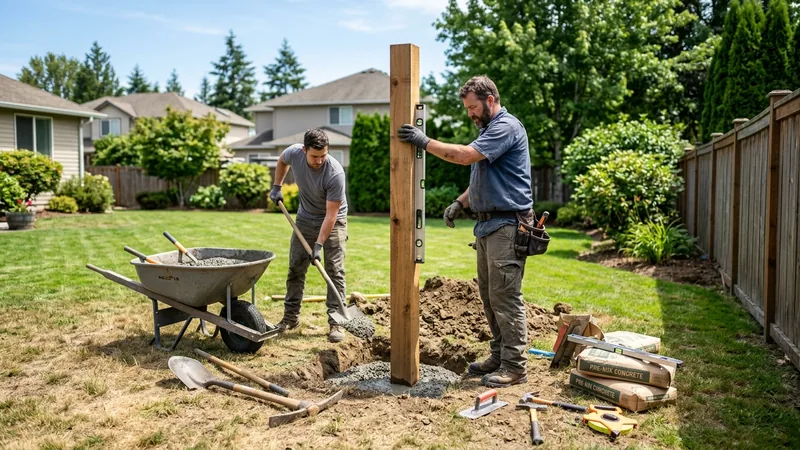
If you choose to build it yourself, you must purchase or rent specialized tools, including a post-hole digger, circular saw, drill, and shovel. You will also need to purchase concrete for post bases at roughly $0.30 per pound Angi.
Hiring a professional ensures that posts are set below the local frost line to prevent shifting, leaning, or sagging over time HomeAdvisor. A pro also handles the coordination of working around local utilities and municipal permit approvals.
Before signing any contract, ensure you are comparing identical scopes of work. Ask whether old fence removal, post cap installation, and gate hardware are included in the base estimate or listed as separate line items.
Quick Answers
How much does a gate add to the cost of a fence?
A basic manual gate typically costs between $150 and $400, while premium materials can run up to $1,200. Automated security gates can cost several thousand dollars HomeAdvisor.
Do I need a permit to install a fence?
Most municipalities require a special permit for fences over 7 feet tall. Standard permits generally cost between $20 and $60. Always check with your local HOA and city building department before starting Angi Privacy Fence.
How far apart should fence posts be spaced?
Fence posts are typically spaced 4, 6, or 8 feet apart. Your local building codes and the weight of your chosen material will dictate the exact spacing and concrete depth required HomeAdvisor.
Compare two quotes on the same scope
Illustrative inputs. Add confirmed extras once; do not double-count items already included. This compares totals, not workmanship, licensing or contract terms.
Sources and research notes
Research checked 2026-09-24. Source comparison; this is a research synthesis. Findings attributed to other reviewers remain their work.
- How Much Does Fence Installation Cost? [2026 Data] | Angi | Angi
- How Much Does a Privacy Fence Cost to Install? [2026 Data] | Angi
- How Much Does It Cost to Install a Fence? [2025 Data]
- 2026 Fence Installation Cost | Get Price Quotes From Local Pros
What the evidence does not establish
- Actual local bids will vary based on regional labor rates, soil conditions, and specific property layouts.
- Material prices are subject to market fluctuations and local availability.
Keep reading
 Bathroom
How Much Does a Bathroom Remodel Cost?
Planning a bathroom renovation? Learn about average bathroom remodel costs, labor rates, material tiers, and ROI expectations to build an accurate budget.
 Electrical
How Much Does It Cost to Upgrade an Electrical Panel?
Learn the costs to upgrade or replace an electrical panel, including amperage options, labor rates, and EV charger readiness.