How Much Does It Cost to Pave a Driveway?
Before you sign a contract, break down the real costs of materials, labor, and site preparation for your new driveway.
On this page
- TradeDriveways and decks
- Read time5 min
- Data tables1
- StatusResearch updated 2026-09-24
Asphalt vs. Concrete vs. Pavers: Cost per Square Foot Installed
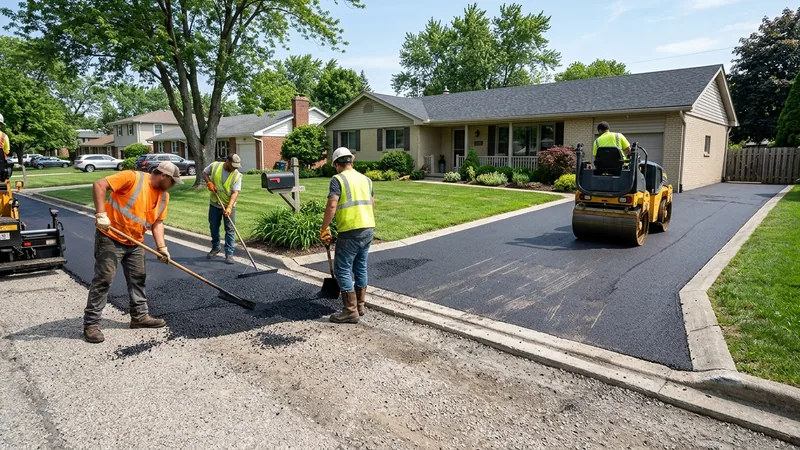
When planning a driveway project, your choice of material is the single largest factor dictating the final invoice. Each material comes with distinct upfront installation costs, lifespans, and maintenance requirements. For a standard installation, expect the following price ranges per square foot, which include both materials and professional labor:
- Gravel: $1.25 to $10.00 per square foot [Thumbtack], [HomeGuide]. This is the most budget-friendly option, though it requires regular raking and replenishment.
- Asphalt (Blacktop): $7.00 to $15.00 per square foot [Angi]. Asphalt is highly flexible and handles freezing temperatures well, but it must be sealed periodically.
- Concrete: $8.00 to $20.00 per square foot [Angi]. Concrete is highly durable and lasts up to 40 years, though it is prone to cracking in extreme cold.
- Driveway Pavers: $10.00 to $30.00 per square foot [Angi]. Pavers offer premium curb appeal and are easy to repair individually, but they require intensive manual labor to install.
If you are coordinating multiple outdoor improvements, you might also want to review our guides on deck building costs and fence installation costs to budget your entire yard remodel effectively.
Cost by Driveway Size
Driveway pricing is heavily scaled by square footage. A standard single-car driveway is typically around 200 to 288 square feet, while a standard two-car driveway averages 400 to 576 square feet. The table below outlines typical professional installation cost ranges (labor and materials included) across common dimensions:
| Driveway Size & Capacity | Square Footage | Asphalt Cost Range | Concrete Cost Range | Paver Cost Range |
|---|---|---|---|---|
| 10' x 20' (1-Car) | 200 sq. ft. | $1,400 – $2,600 | $1,600 – $3,000 | $2,000 – $6,000 |
| 12' x 24' (1-Car) | 288 sq. ft. | $2,000 – $3,700 | $2,300 – $4,300 | $2,900 – $8,600 |
| 20' x 20' (2-Car) | 400 sq. ft. | $2,800 – $5,200 | $3,200 – $6,000 | $4,000 – $12,000 |
| 24' x 24' (2-Car) | 576 sq. ft. | $4,000 – $7,500 | $4,600 – $8,600 | $5,700 – $17,200 |
| 24' x 36' (3-Car) | 864 sq. ft. | $6,000 – $11,200 | $6,900 – $13,000 | $8,600 – $25,900 |
Note: Range assumptions are based on standard flat-ground installations. High-end decorative finishes, custom patterns, or structural thickness upgrades will push totals toward or beyond the upper limits.
What Drives the Price?
When you receive a professional bid, the total is rarely just a reflection of square footage. To understand how to evaluate your estimate, you must break the project down into its core cost drivers:
1. Labor and Equipment
Labor typically accounts for 40% to 50% of the total project cost [Angi]. Paving requires heavy industrial machinery, including skid steers, rollers, plate compactors, and dump trucks. Standard labor rates for laying pavers run from $6.00 to $10.00 per square foot [HomeGuide], while concrete labor ranges from $2.00 to $10.00 per square foot depending on the complexity of the finish [Angi].
2. Site Preparation and Grading
A driveway is only as stable as its subbase. If your property requires grading to ensure proper water drainage, expect to pay $3.00 to $8.00 per square foot for professional grading services [HomeGuide]. Removing trees, large rocks, or thick vegetation will add to this prep work fee.
3. Demolition and Disposal
If you are replacing an existing driveway rather than building on a clean site, you must account for demolition. Removing an old concrete driveway typically costs $2.00 to $6.00 per square foot, while removing old asphalt costs $1.00 to $2.00 per square foot [HomeAdvisor]. Ensure your contractor's quote explicitly states whether hauling and disposal fees are included in this rate.
4. Accessibility and Layout
Straight, flat rectangular driveways are the easiest and cheapest to pave. If your driveway is on a steep slope, expect to pay an extra $1,000 to $2,500 for specialized excavation and grading [HomeAdvisor]. Curved layouts (such as L-shapes, S-shapes, or circular designs) increase costs by 10% to 30% because they require custom forms and more intricate hand-cutting of materials [Angi].
Sealing, Resurfacing, and the 30-Year View
Upfront installation costs only tell half the story. To make an economical decision, you must look at the long-term maintenance cycle of each material over a 20- to 30-year period:
- Asphalt Maintenance: While cheaper upfront, asphalt must be sealed every 3 to 5 years to prevent cracking [HomeGuide]. Professional asphalt sealing costs $1.25 to $1.50 per square foot [Angi]. Over 30 years, these recurring costs can close the price gap between asphalt and concrete.
- Concrete Maintenance: Concrete requires very little upkeep beyond occasional cleaning and optional sealing. However, if concrete does crack or sink, repairs are highly expensive, often costing $300 to $3,000 depending on the severity [HomeGuide].
- Paver Maintenance: Pavers are highly durable and resist cracking because the joints allow for natural ground movement. If a paver is stained or damaged, you can replace that individual block for a minimal cost rather than repaving the entire surface [HomeGuide].
DIY vs. Professional Installation
Paving a driveway is not a recommended DIY project for most homeowners. While you can save approximately $1.15 per square foot by sealing an existing asphalt driveway yourself [HomeAdvisor], pouring concrete or laying hot-mix asphalt requires specialized heavy machinery and precise timing. Improper grading or subbase compaction will lead to rapid pooling water, cracking, and premature driveway failure, costing thousands of dollars to correct.
When hiring a professional, always request a detailed, written estimate. For guidance on how to evaluate these documents, read our guide on how to read a contractor quote. We recommend obtaining at least three written bids with identical scopes of work (covering excavation, base depth, material thickness, and disposal) before making your hiring decision.
Quick Answers
How long does a paved driveway last?
An asphalt driveway typically lasts 15 to 30 years, while a concrete driveway lasts 30 to 40 years with proper care. Paver driveways are the most durable, often lasting 25 to 75 years.
How soon can you drive on a newly paved driveway?
New asphalt typically cures enough for vehicle traffic within 1 to 3 days. Concrete requires a significantly longer curing time, usually taking 7 to 30 days before it can support heavy vehicles.
Do I need a permit to pave my driveway?
Yes, most municipalities require a permit for new driveway installations or expansions, which typically costs between $50 and $250. Permits are often waived if there is already a driveway apron connecting your home to a public street.
Compare two quotes on the same scope
Illustrative inputs. Add confirmed extras once; do not double-count items already included. This compares totals, not workmanship, licensing or contract terms.
Sources and research notes
Research checked 2026-09-24. Source comparison; this is a research synthesis. Findings attributed to other reviewers remain their work.
- How Much Does an Asphalt Driveway Cost in 2026?
- How Much Does a Concrete Driveway Cost in 2026?
- How Much Does a Paver Driveway Cost? [2026 Data]
- How much does driveway installation cost?
- How Much Does a Driveway Cost? (2026)
- How Much Does It Cost to Pave a Driveway? [2026 Data] - Angi
- How Much Does It Cost to Install Driveway Pavers? (2026)
- How Much Does a Concrete Driveway Cost? (2026)
- How Much Does It Cost to Repave a Driveway? [2025 Data]
- How Much Does an Asphalt Driveway Cost vs. Concrete (2026)
- How Much Does It Cost to Seal an Asphalt Driveway? | Angi
- How Much Does It Cost to Seal an Asphalt Driveway? [2026 Data]
What the evidence does not establish
- Local labor rates, soil conditions, and regional material availability can cause actual bids to vary significantly from national averages.
Keep reading
 Driveways and decks
How Much Does It Cost to Build a Deck?
Planning to build a deck? Learn about the real cost drivers, including materials, labor, permits, and site access, with practical budgeting advice from Cal Bennett.
 Bathroom
How Much Does a Bathroom Remodel Cost?
Planning a bathroom renovation? Learn about average bathroom remodel costs, labor rates, material tiers, and ROI expectations to build an accurate budget.